I’ve recently moved my writing over to substack where you can still access my writing for free.
Now and next
Months have elapsed since my last post. After writing it I’d resolved to post more frequently here, finding social media a far too fast paced and noisy space. Perhaps this now becomes a resolution for 2024.
The past year has been one of changes in my working life and adjusting to the end of the hyperfocus of PhD thesis writing. Highlights have been three community-based textile heritage projects here in Bradford, Repair, Together with Needle and Thread and Lost Mills and Ghost Mansions; my Arts Council England DYCP project Extraction; the first of a series of heritage events in Ghent (Leeds and Tilburg to follow in 2024) using textile history to connect with community, co-creation and making; teaching, both online on my Stitching Connection course and at West Dean College, The Lund, and Museum Dr Guislain, Belgium; development work for two conferences in 2024, focussing on textile cities and refugee stories. Finally in October I was delighted to begin a one year postdoctoral ESRC fellowship at The Open University, Crafting Resilience, which gives me time to disseminate work from my thesis and to develop some new research proposals.
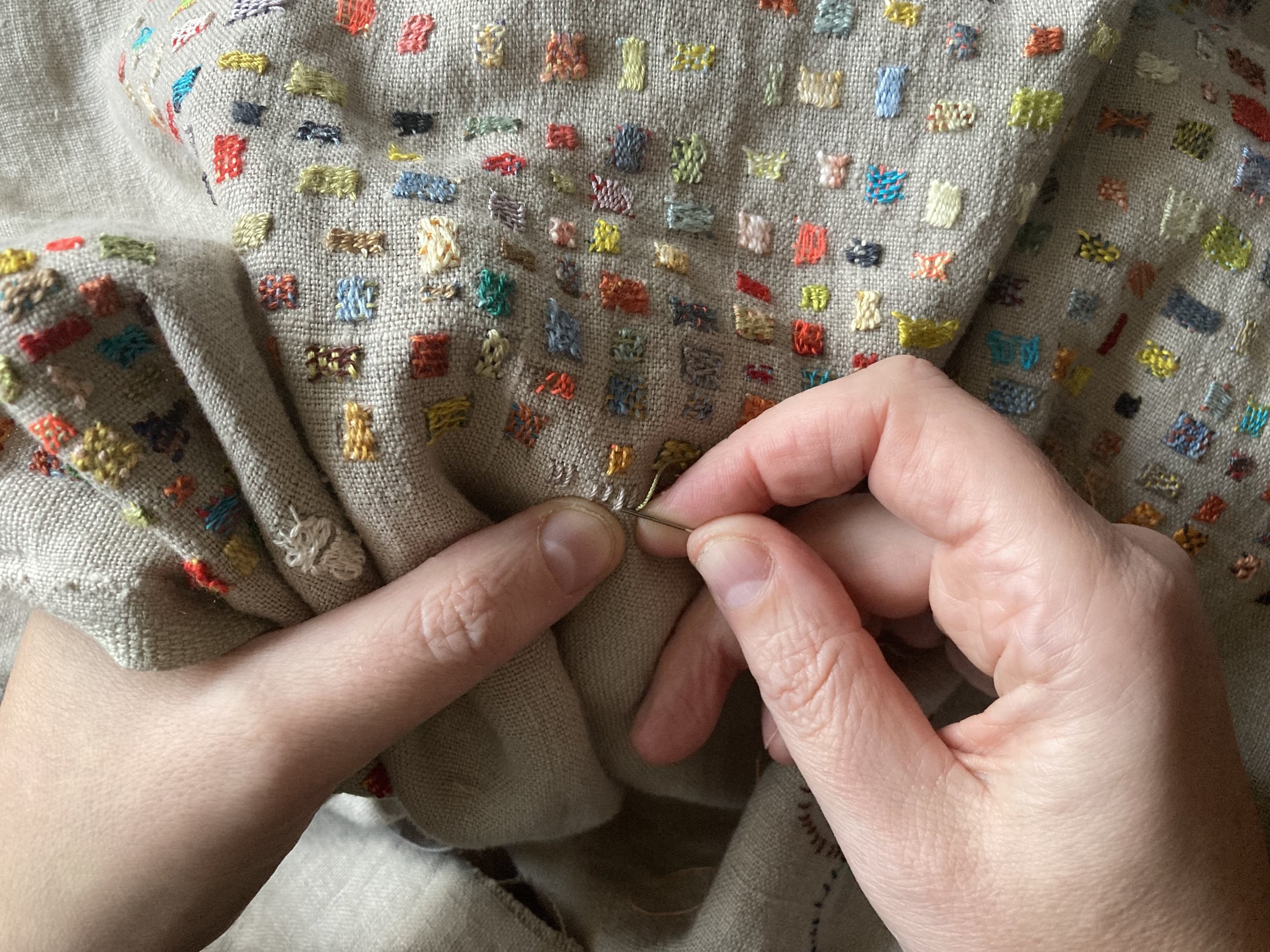
This year also marked ten years of my daily stitching practice, my Stitch Journal. The daily stitching continues, my current piece shown above. Once again, I find the rhythm of hand stitch, the familiarity of my choice of materials and the reflective space it offers me, a significant part of everyday and working life. 2024 will bring more piecing and patching together using textile as a thread running through plans for projects, developed over time, which will hopefully begin in 2025.
I’m hugely grateful to readers, publishers, funders and commissioners, mentors and mentees, workshop and community participants for continuing to support my work and look forward to sharing more in due course.
Extraction
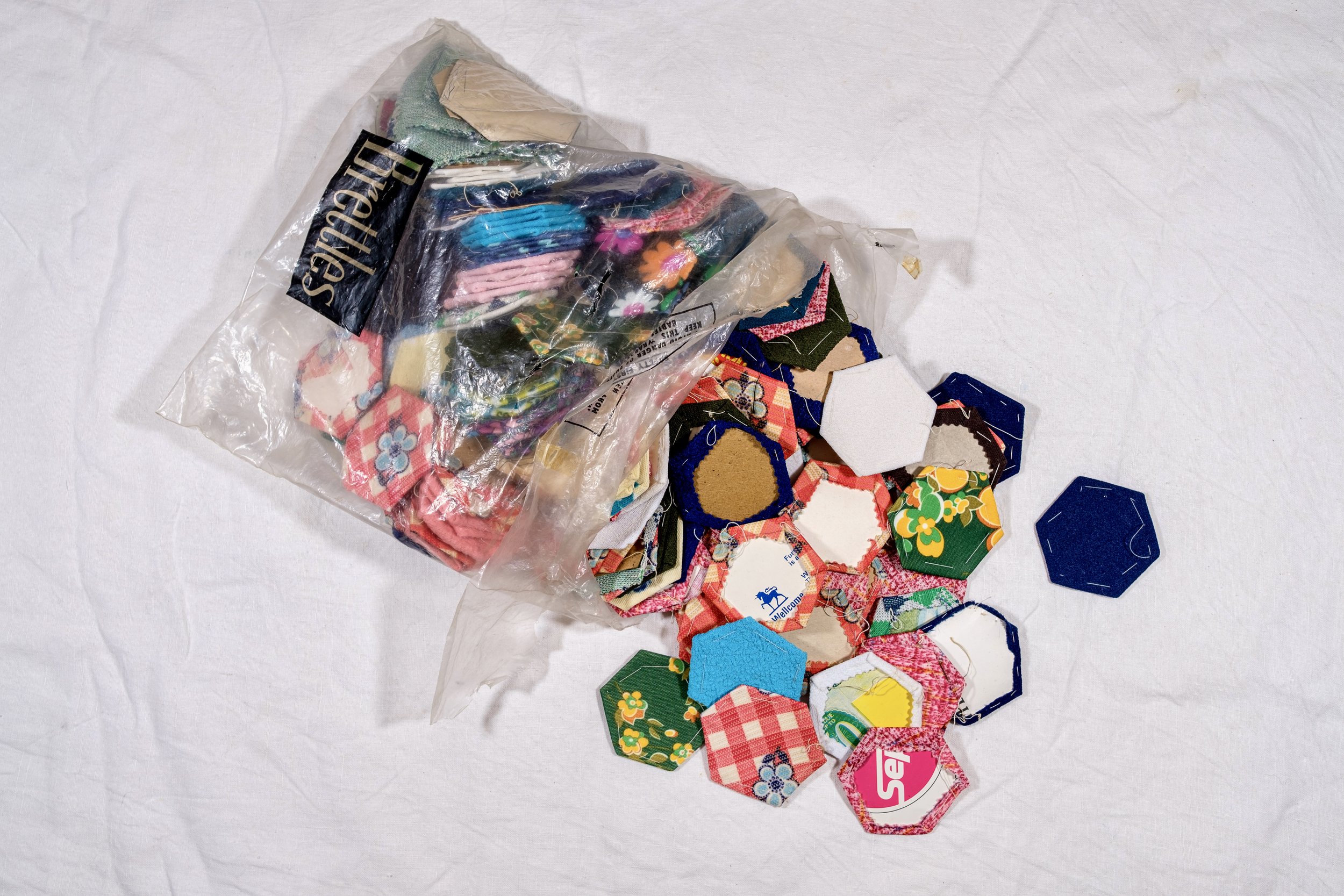
An Archive of Extraction: Crimplene (image by Phil Jackson)
Thanks to an Arts Council England DYCP award I have spent some time over the last six months developing and researching a new project ‘Extraction’. It has allowed me the space to research and think through, using materials, the complex trajectories that connect industrial synthetic textile production and consumption to the climate crisis. I have learned more about the development of synthetics in the context of the British textile industry and researched labour stories in northern England and communities that made them. I interrogated the idea of extraction through my own practice including work over many years with natural materials and plant dyes. This has been a challenging process, as I have also worked through ideas of extractive practices in socially-engaged work and the politics of care.

An Archive of Extraction: Terylene (image by Phil Jackson)
As part of the award I worked with mentoring support for my curatorial practice and with artists around aspects of studio practice. I will be developing the project to explore the global scale of the mobilities and geographies of these materials over the next two years.

a decade in stitches
On a long-archived blog that I began in 2002 one of my final posts shared the beginning of my (almost) daily Stitch Journal. I spent a bit of time this weekend archiving nearly ten metres of it - recycled linen pieces joined together and densely stitched, mainly with threads I dyed myself. I’d been inspired by Judy Martin’s durational work Not To Know But To Go On, and her description of ‘time as a material.’*
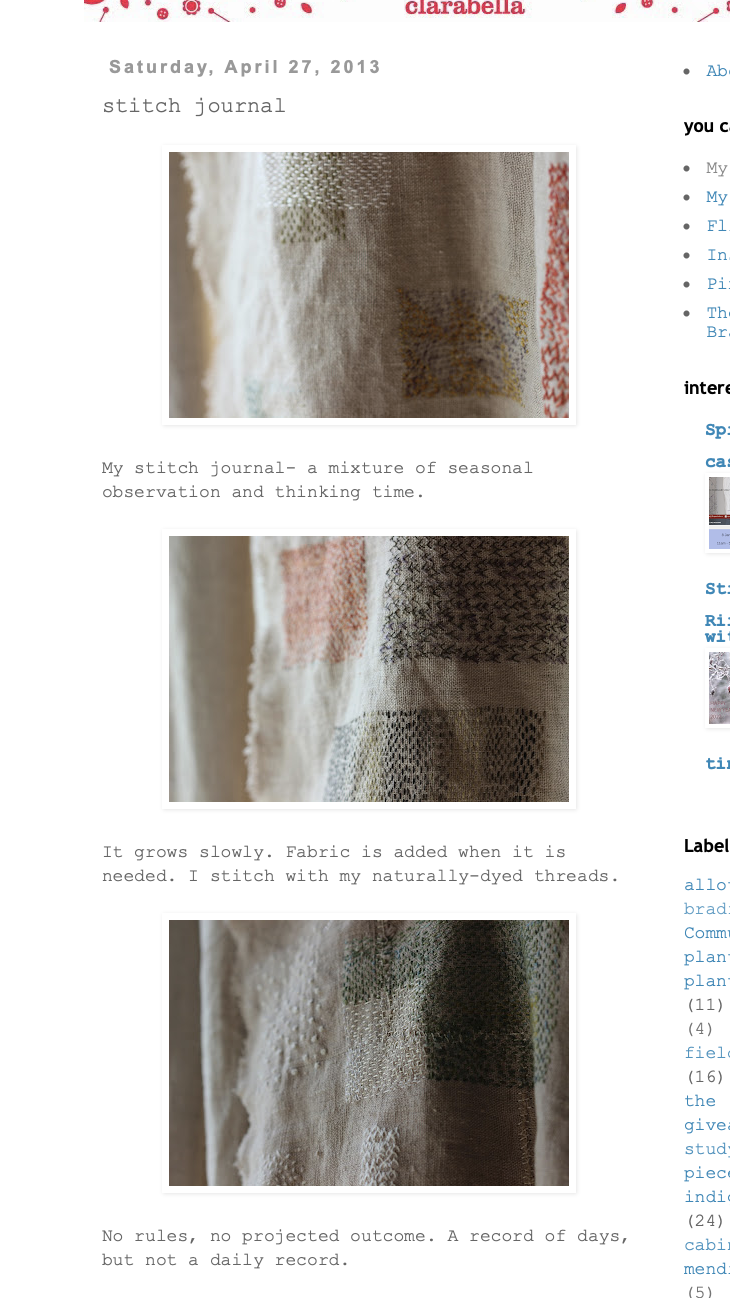
Over ten years this daily stitching has accompanied a great deal of change, in family life and my working practices. I can chart highs and lows, terrible grief and new hope across its surface. It has offered me a deep understanding of the materials I use and how they behave. I see my hand stitches as a kind of writing: my socially engaged projects, studio practice and research all find their way in.

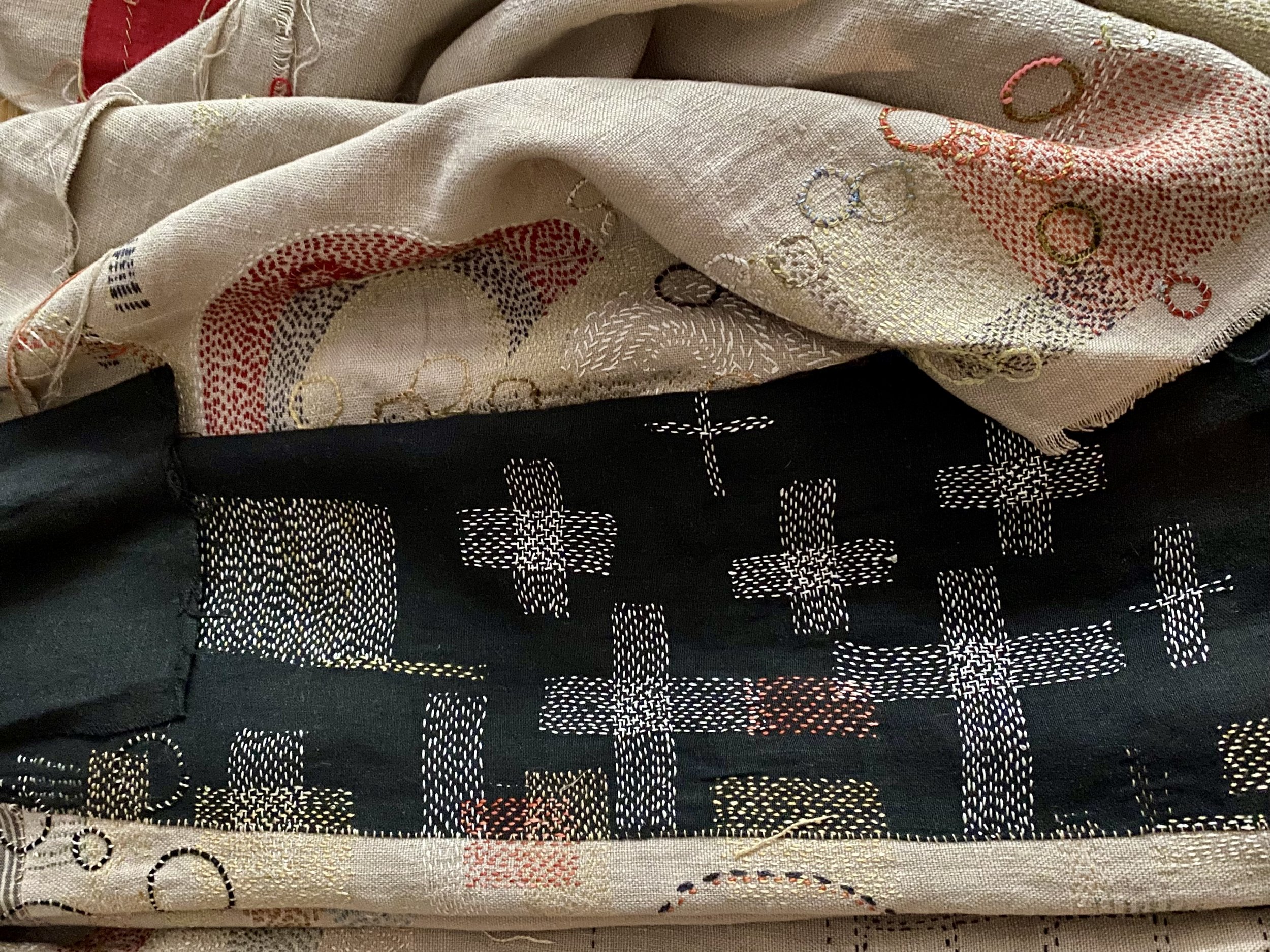
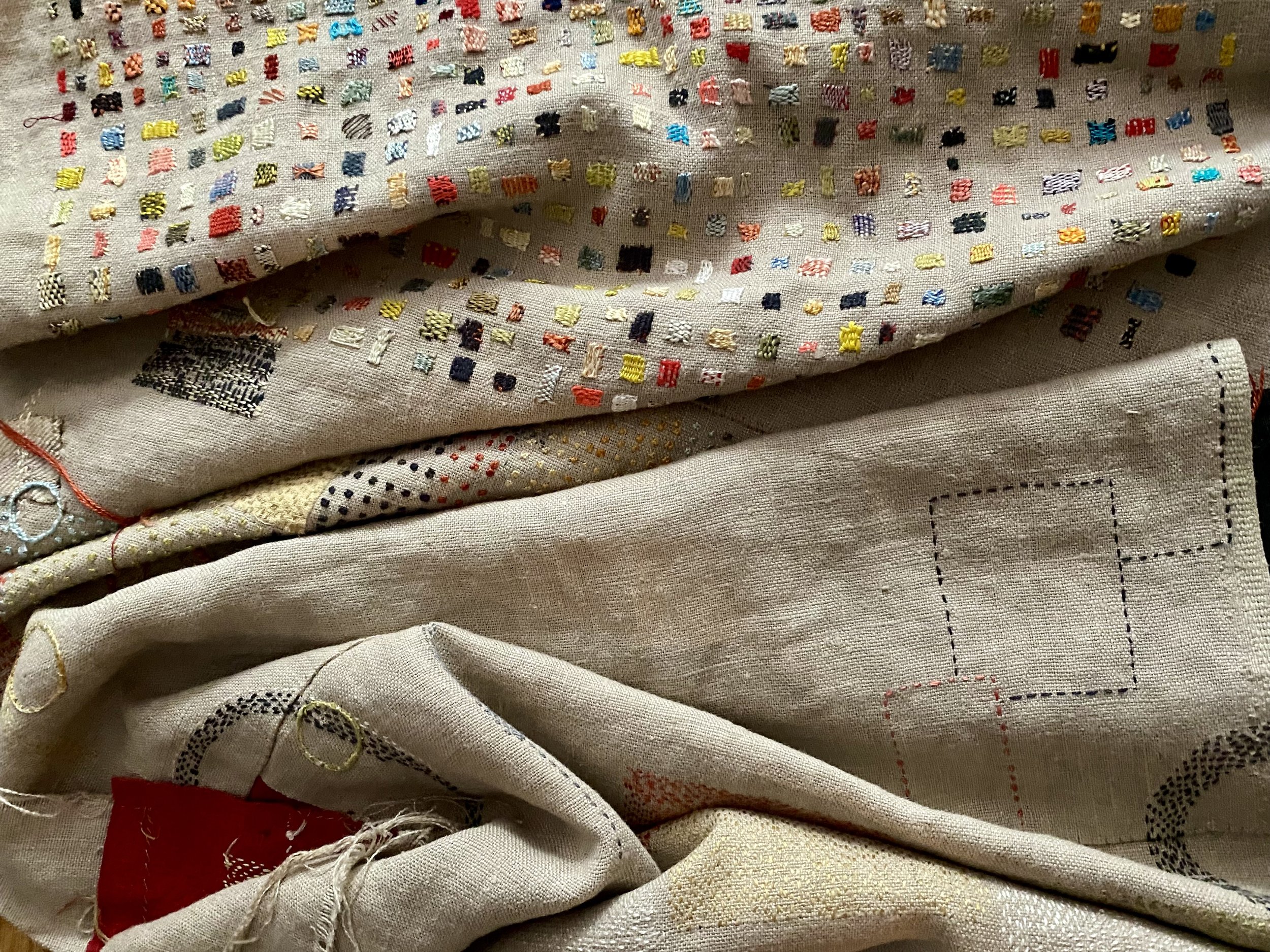
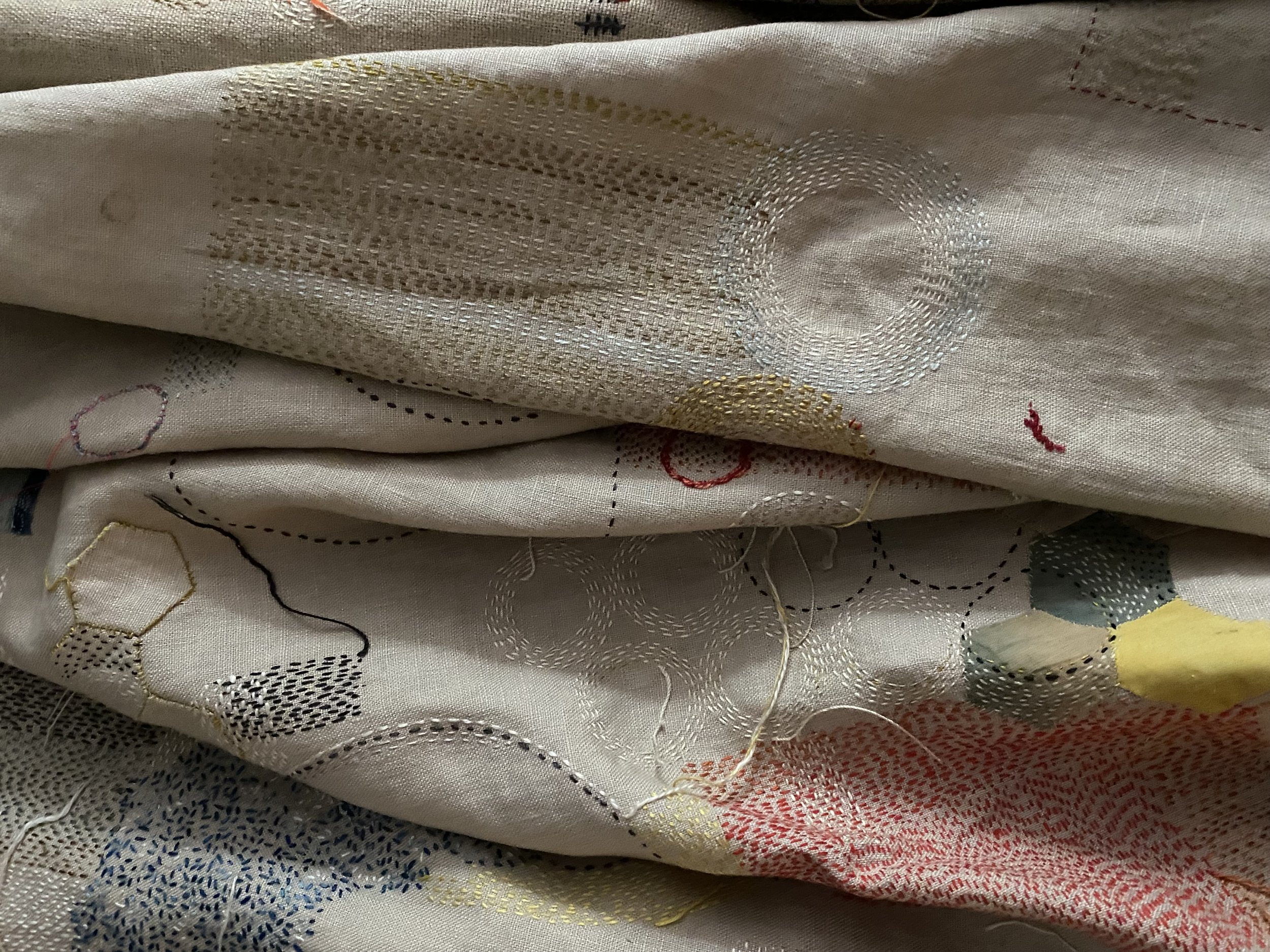
For now the first ten years have been archived in my studio.


I plan to continue this material commitment, using thread and cloth to think with alongside new projects currently in development.
* included in Slow Stitch: Mindful and Contemplative Textile Art (2015)
Together with needle and thread: Legacies of Louisa Pesel

Louisa Pesel teaching at the Bradford Khaki Handicrafts Club, 1917 [image courtesy of University of Leeds Special Collections]
Louisa Pesel (1870-1947) was born in Manningham, Bradford and a recent project working with volunteers and participants living in that area has explored her connections to the city. Pesel is known for her work in later life with the Winchester broderers and for setting up what became the Embroiderers Guild. This project, supported by Bradford Metropolitan District Council, focussed on her life in the City, particularly during the First World War. Pesel came from an affluent family who were highly involved in the social and cultural life of the city. Her parents were part of a network of educated, engaged citizens who were involved in charitable works and the life of the Unitarian Chapel. This project has uncovered Pesel’s connections to the Belgian Institute, opened for a newly arrived community of Belgian refugees in late 1914. This building, on Manor Row in the city centre, provided workshop facilities for the new arrivals including woodworking, cobbling, millinery, toy making and dressmaking. Later in the war Pesel was instrumental in setting up the Bradford Khaki Handicrafts Club for soldiers resident in the Abram Peel Hospital experiencing the psychological impacts of the war. I wrote about this project in my second book, Resilient Stitch: Wellbeing and Connection in Textile Art.
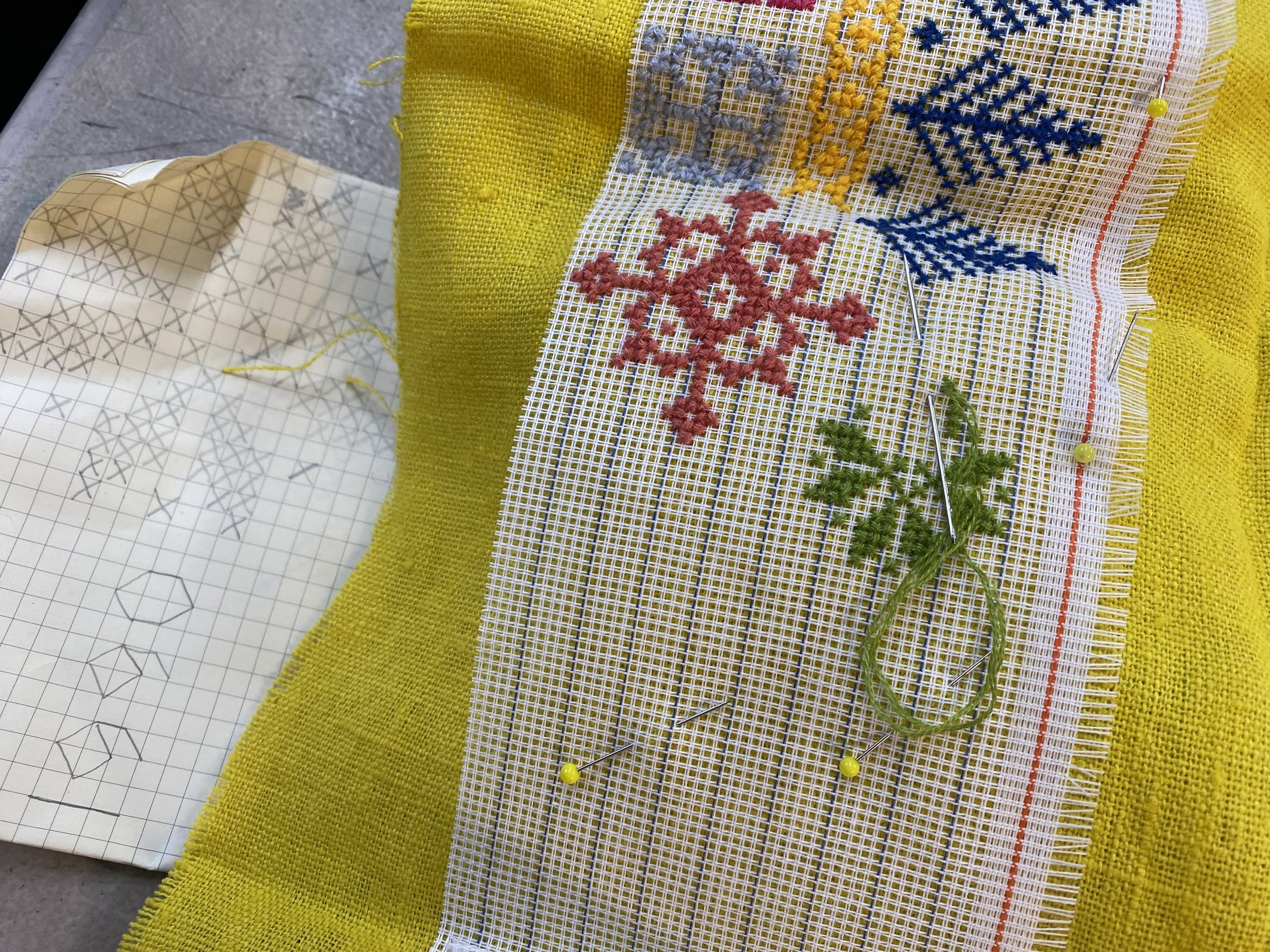
Participant work in progress using canvas work techniques inspired by Pesel archive materials at The University of Leeds
The project has worked with a team of fantastic community researchers who have uncovered many more details about Pesel’s Bradford connections. Groups from the refugee and asylum seeking community and others have worked on textile projects exploring their personal wellbeing. We have been keen to look at the heritage of textile work and health and wellbeing through the lens of Pesel’s work and used archive material in the University of Leeds Special Collections to evidence this. A small publication exploring these themes and written by the researchers and myself is available to read online.
Repair


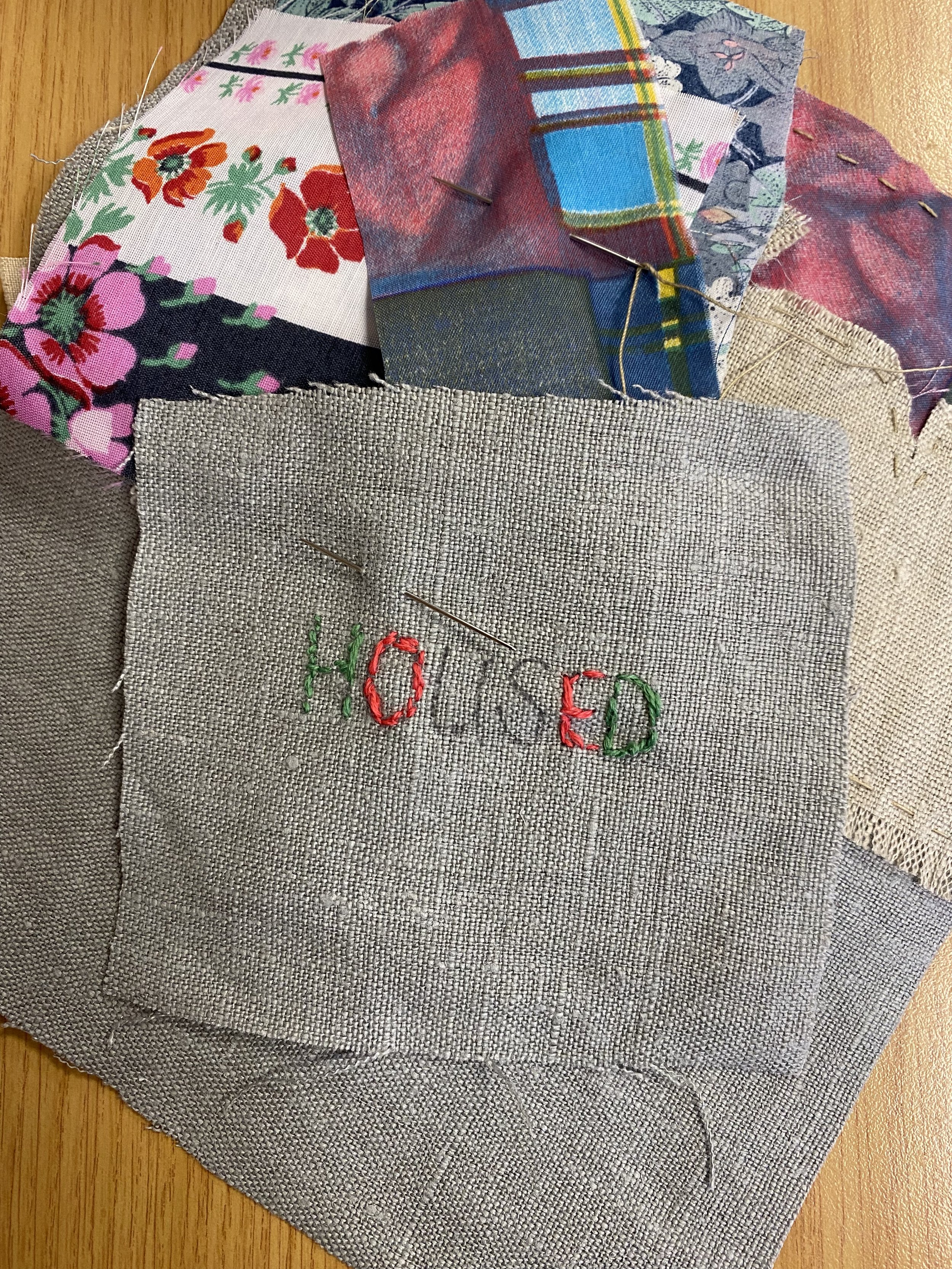

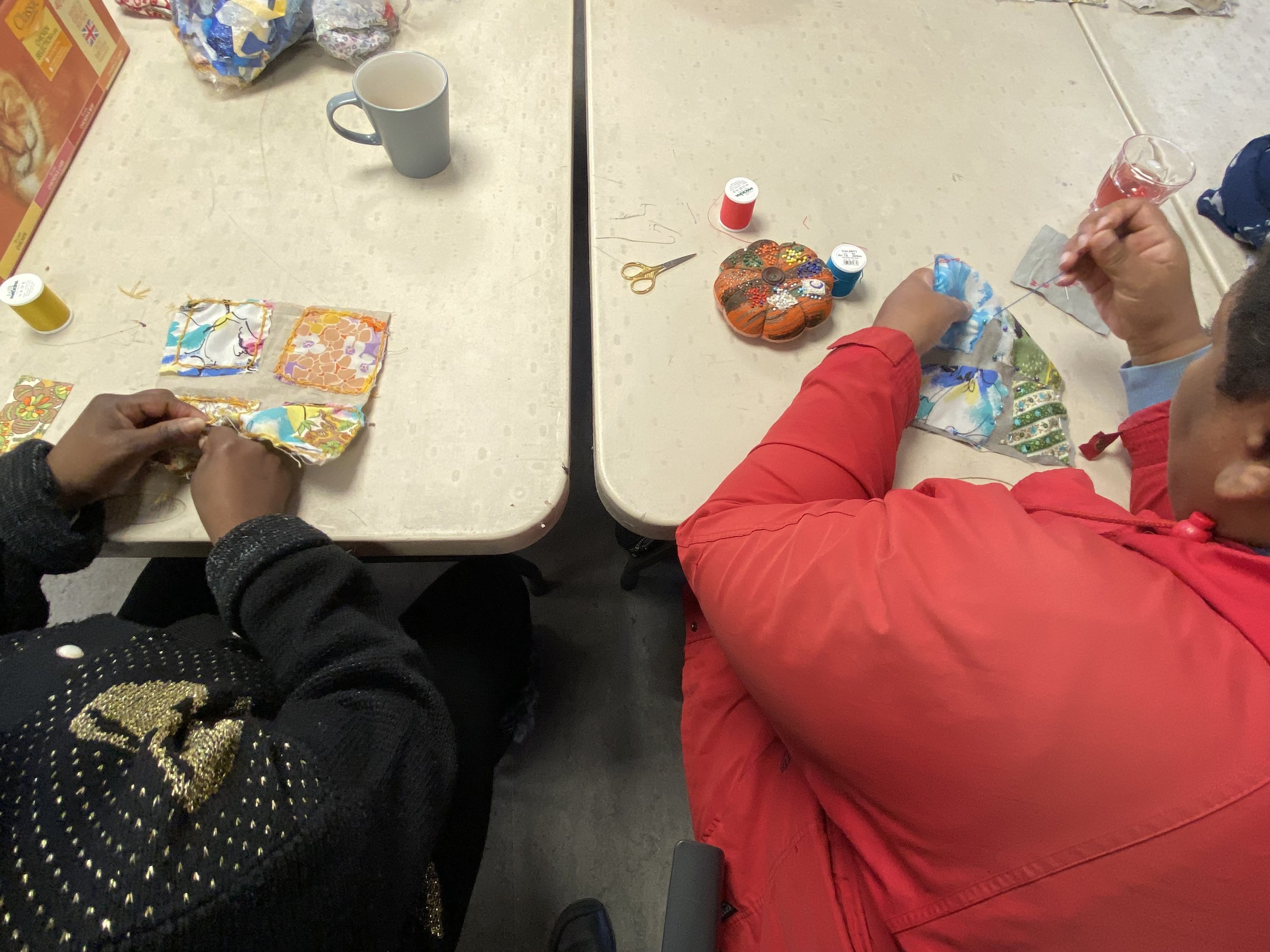
Repair is a recent local project that coincided with the demolition of a 1970s housing estate, described as utopian at the time, Ripleyville in West Bowling, an area of South Bradford. The estate, built in 1975, replaced an earlier industrial model village (c.1868), also named Ripleyville, after Henry Ripley a textile dyeing industrialist who initiated the project. The project questioned how we think about change and repair in the context of the demolition and worked with women from the local community, some of whom had lived in the flats. We explored perceptions of the housing and the experience of living there through textile work. This included thinking about the language we use around community and the reality of social housing experiences. We worked with archives, materials and personal objects that had connections to the industrial heritage of West Bowling, where Bowling Dyeworks dominated the landscape until the middle of the twentieth century. We used the heritage to find ways of visual storytelling about change and community. This project strongly connected to my research project with The Open University exploring community resilience and wellbeing through the use of craft in former areas of industrial textile production.
I worked with the heritage of West Bowling and Ripleyville nearly ten years ago on a socially engaged project exploring the textile dyeing heritage of Bradford, The Fabric of Bradford, and a personal project ‘Dyer’s Field’. The landscape changes but working with textiles can offer new ways of thinking through this, a participant commenting, ‘It’s been a gentle way of talking about how you say goodbye to things.’
Repair took place at Shine, St Stephen’s Church, West Bowling and was supported by a Bradford Culture Commission grant. Many thanks to Sam Thirkhill, Sarah Hinton and the Creative Threads group.
Connective Material
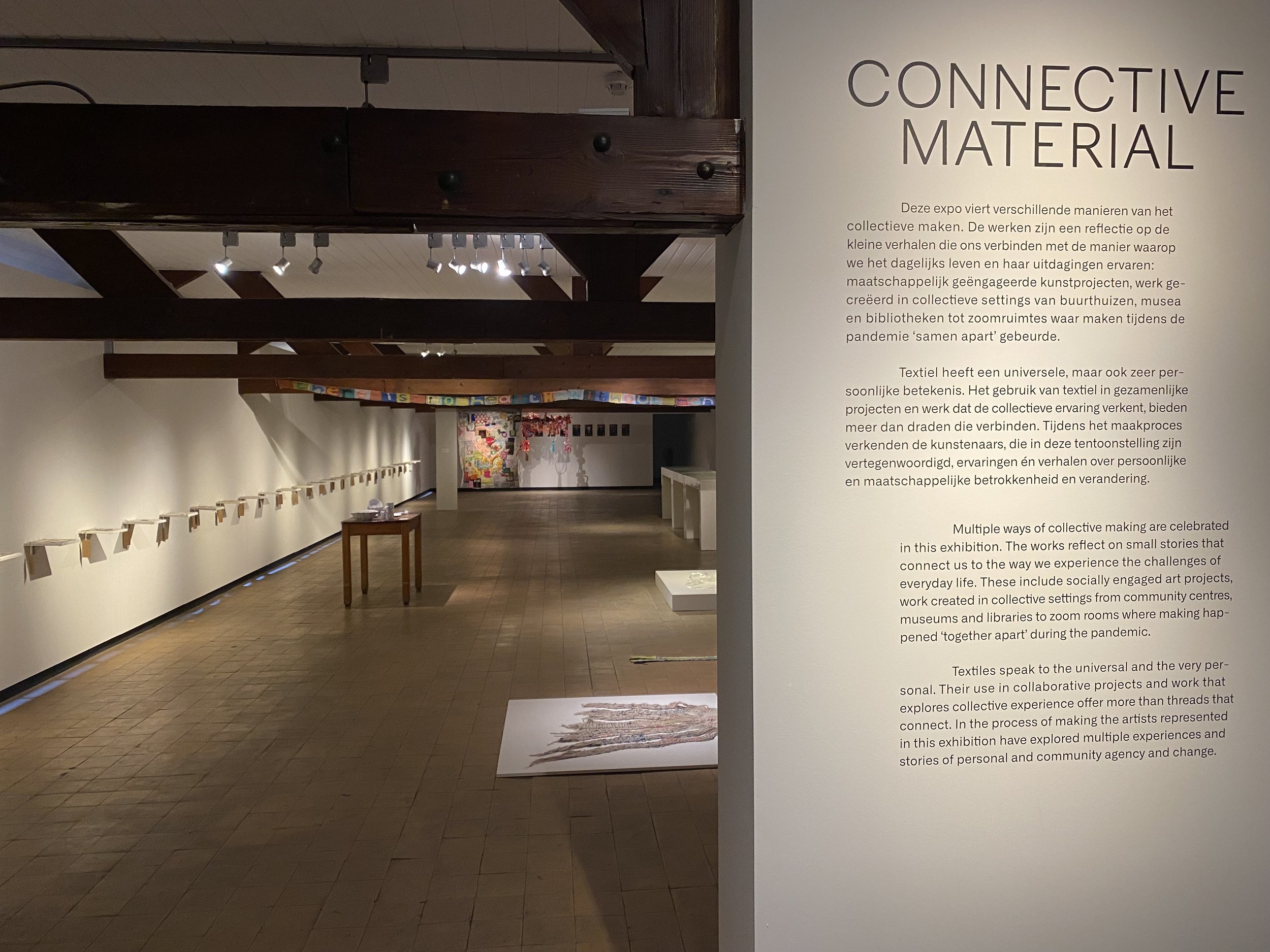
Since the beginning of this year I’ve been working on a project with Museum Dr Guislain, Ghent, Belgium alongside preparations for an international conference Culture and Mental Health (with Iedereen Leest, the Flemish Reading Agency). The exhibition I curated as a response to the themes of the conference: connection, mental health, growing and making, and literature is now open.
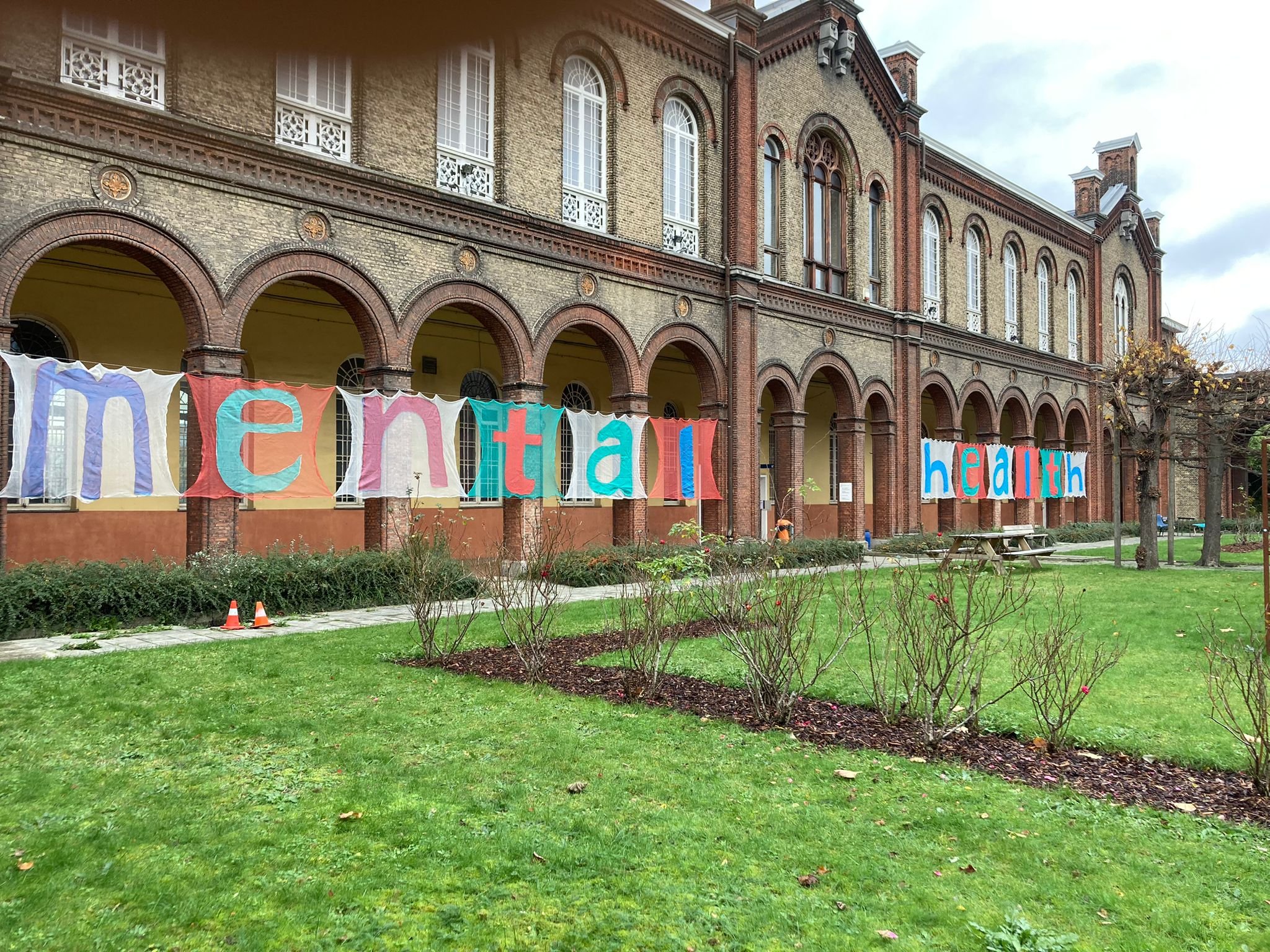
Lynn Setterington (2021) ‘Safety Net’
Connective Material celebrates multiple ways of collective making: the work reflecting on small stories that connect us to the ways we experience the challenges of everyday life. It includes socially engaged arts projects BindweefselLevensboom (Tree of Life) (2022) Larissa Schepers in collaboration with participants of the project and made with TextielLab at the Textiel Museum, Tilburg, Netherlands - making that symbolises the rich cultural and personal stories of participants; I MISS YOU (2021) Erin Helsen and Valentine Kempynck who worked with families and the organisation DOEK vzw (Antwerp) this digital piece focussing on stitched reflections on loss and grief. Louise Limontas shows work developed during a residency with KAOS vzw, a Brussels-based organisation that develops art projects and residencies in psychiatric settings. her woven Intangibles rencontres (2021) explore encounters and exchanges both verbal and non-verbal both during collaborative workshops at the Sint-Alexius atelier and afterwards. Safety Net (2021) and There is no Health without Mental Health (2019/20) are work by Lynn Setterington developed as part of a project exploring mental health and the construction industry in the UK. They are made with debris netting, and were originally shown in Manchester, installed by local scaffolders. Transition Quilt (2020 ongoing) by Al Hill, Colin Lievens, Eleanor Louise West and Joe Lawn, has been made collaboratively, ‘used, lived in, and added to’ as it has been passed back and forth between makers. The quilt has undergone its own transition, providing love, comfort and solidarity. The Bradford Covid Stitch Journal (2020) Claire Wellesley-Smith and participants is an early response to the first lockdown in the UK and was made between April and July 2020. Participants explored their feelings about the pandemic through stitch and in online conversations.

Installation view: Connective Material
In addition to these participatory works, individual pieces by Angela Maddock, Shelly Goldsmith and Karina Thompson are included. All three speak to stories of the collective or to mental health. Holding: A Work in Progress (2017-2022) by Angela Maddock is an ongoing series made in response to conversations with nursing and midwifery students at Kings College London on their experiences of holding and containing in the context of clinical practice. Recovery Quilt 3: Out of the Dirt (2019) by Karina Thompson is a reflection on the lived-experience of clinical depression. Lodz Blouse Trilogy (2018) by Shelly Goldsmith explores memory and experience imbued in the clothes we wear whilst paying homage to the photographer Henryk Ross (1910-1991) and his image ‘Children and parents gathered around the table at a children’s party.’ 1942-1944.
Still from I MISS YOU (2021) Erin Helsen and Valentine Kempynck
Big thanks to Bart Marius, Tuur Demaegdt and Yoon Hee Lamot at Museum Dr Guislain for all their support with this project.
Connective Material is on until 30th March 2023 alongside Mirror Mirror: Fashion and the Psyche and Making, Healing, Connecting a project of Soft Connection Lab and the Nomadic School of Arts with students of KASK and Conservatorium School of Arts, Ghent.
More images here
writing (stitching) it down
Nine years of (almost) everyday stitching. A tangle of thread on the back, some of the surface threads now beginning to fade, the 10 metres of recycled linen cloth that make up my Stitch Journal. My choices of thread connect my thinking through community and studio practice and daily life.
I’ve been thinking about stitching and writing again as I come to the end of five years of PhD research with the Open University. I’ve been looking in granular detail at socially engaged arts practices and how they work when exploring specific aspects of textile heritage. This is an ethnographic study of the growing, making, unmaking and remaking of projects, situated in ordinary places.
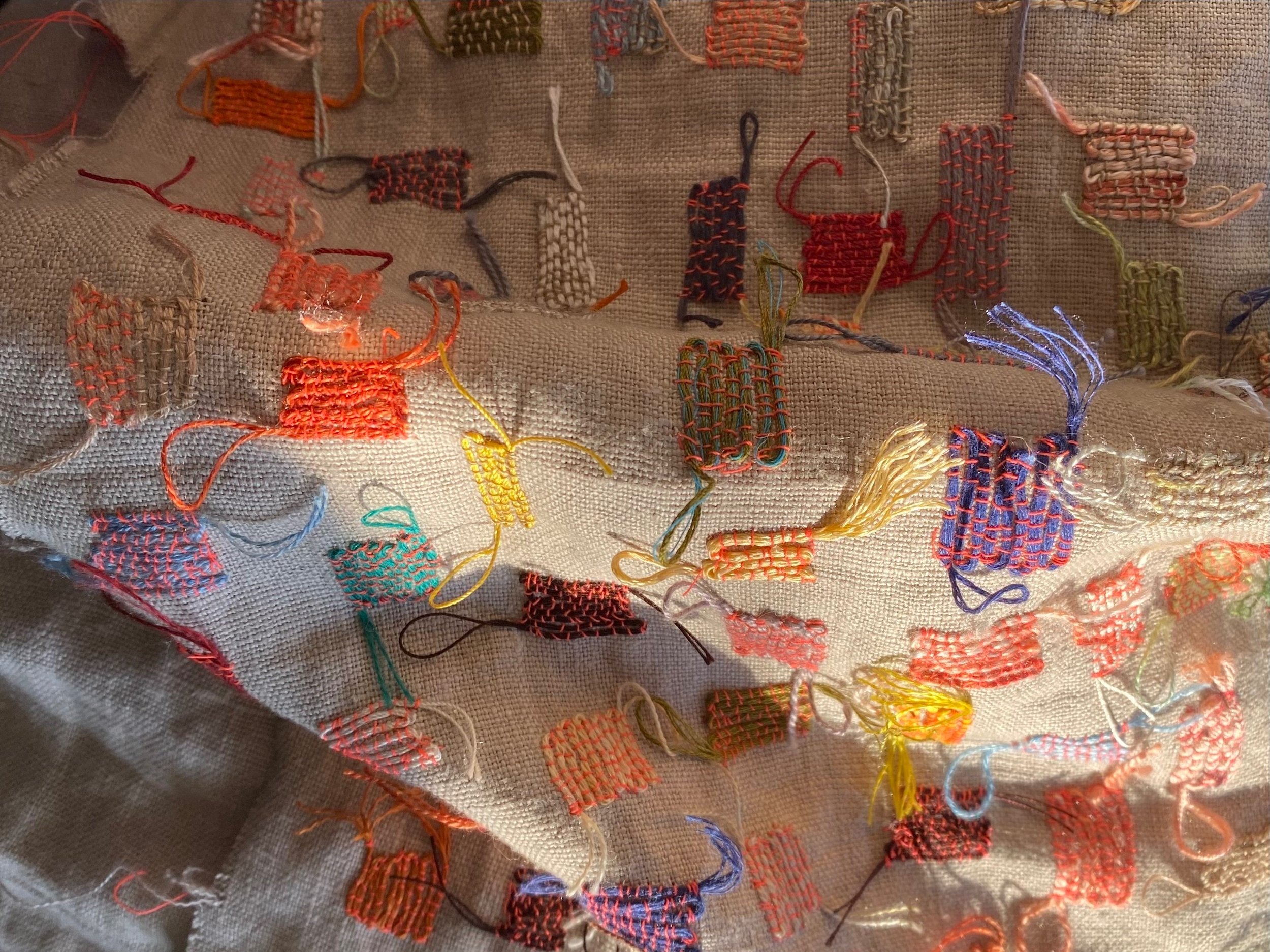
The small needle-woven squares now littering the surface of my cloth echo the painstaking process of editing my work. Short ends of threads, clipped from other stitching and saved over time are woven back in. Adrienne Rich describes, ‘Looking back and seeing with fresh eyes, of entering an old text from a new critical direction’ (1972, p.18). My margin notes to myself suggest that I ‘unpick’ a paragraph; neon thread highlights a sentence or a single word.
I want my words to be as precise as my needle.
Rich, A. (1972) When We Dead Awaken: Writing as Re-Vision College English Vol. 34, No. 1, Women, Writing and Teaching (Oct., 1972), pp. 18-30
Resilient Stitch
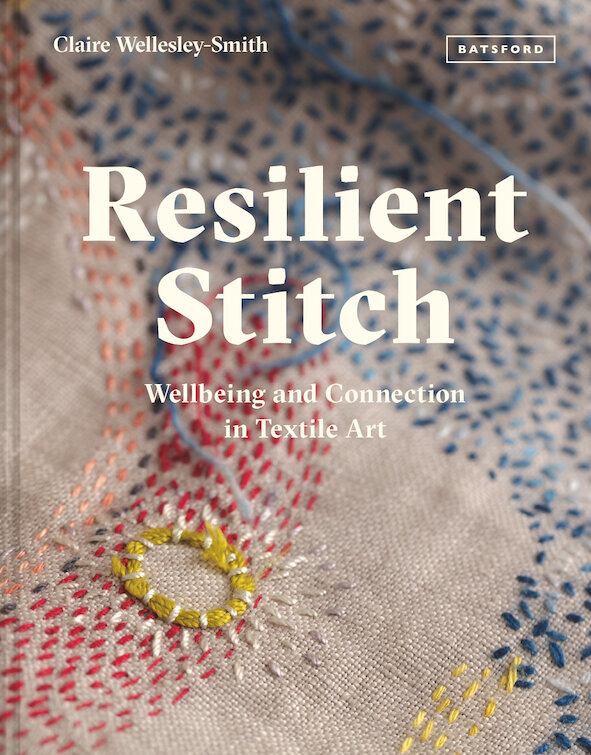
Delighted to finally share the cover of my second book here - a project I’ve been working on since 2018. Resilient Stitch: Wellbeing and Connection in Textile Art will be published by Batsford in April 2021. Resilient Stitch is an exploration of the notion of resilience in textile art and its importance for mental wellbeing, community cohesion and engagement with the environment. It contains mindful and practical stitch exercises using techniques such as piecing and patching, mending, tying and binding, and natural dyeing ideas. It also includes a postscript written in the first phase of the Covid-19 crisis that reflects on this project.
Beautifully illustrated with photographs by Michael Wicks it features work by myself, by community groups and contributions from international artists Lynn Setterington, Raisa Kabir, Amy Meissener, Willemein De Villiers, Alice Kettle, Ruth Singer, Bridget Harvey and Angela Maddock You can preorder Resilient Stitch here and here. I will also have signed copies available through my online bookshop.
Taking stock

Stitch journal: lockdown stitching
As this strange summer draws to a close I’ve had a few quiet days and thought I would write a short update here. I spent my break walking and at my allotment where the rhythms of gathering and processing have speeded up and I’ve noticed a definite shift into autumnal colour. My area of Bradford is about to come out of a local lockdown, the schools return next week and I’m hoping that some better structure might emerge for me in my working days.

Autumn colour at the allotment

Lockdown colours from my backyard, allotment and kitchen waste
I’ve continued to work throughout the Covid crisis, trying to keep some momentum in my PhD, my ongoing project in East Lancashire, the next stage for other projects including the Bradford Covid-19 Stitch Journal and final edits for my second book (I’ll be writing more about this next month). It has felt very improvised and fragmented at times, but I’ve also made new connections with textile practitioners, writers and researchers during this period and begun some interesting conversations. I’ve hugely missed the regular contact of my community practice and thought a lot about who is missing in the increasingly digital-focussed delivery of workshops, talks and projects. Through it all I’ve kept up my daily stitching practice, now in its eighth year. The repetition of my stitches, particularly on more difficult days, has been hugely beneficial to me.

Colour in the allotment dye bed
This autumn I’m looking forward to resuming some teaching, with an in-person stitch retreat at Hope & Elvis and an online session with Selvedge about stitching as a daily practice.
[]
If you have time and access do listen to Stitching Souls, a beautiful documentary from the BBC World Service by Maria Margaronis about the Gee’s Bend quilters. I have also spent some time reading the excellent articles on the Decorating Dissonance website including this interesting reflection on lockdown through the life of nineteenth century German seamstress Agnes Richter